
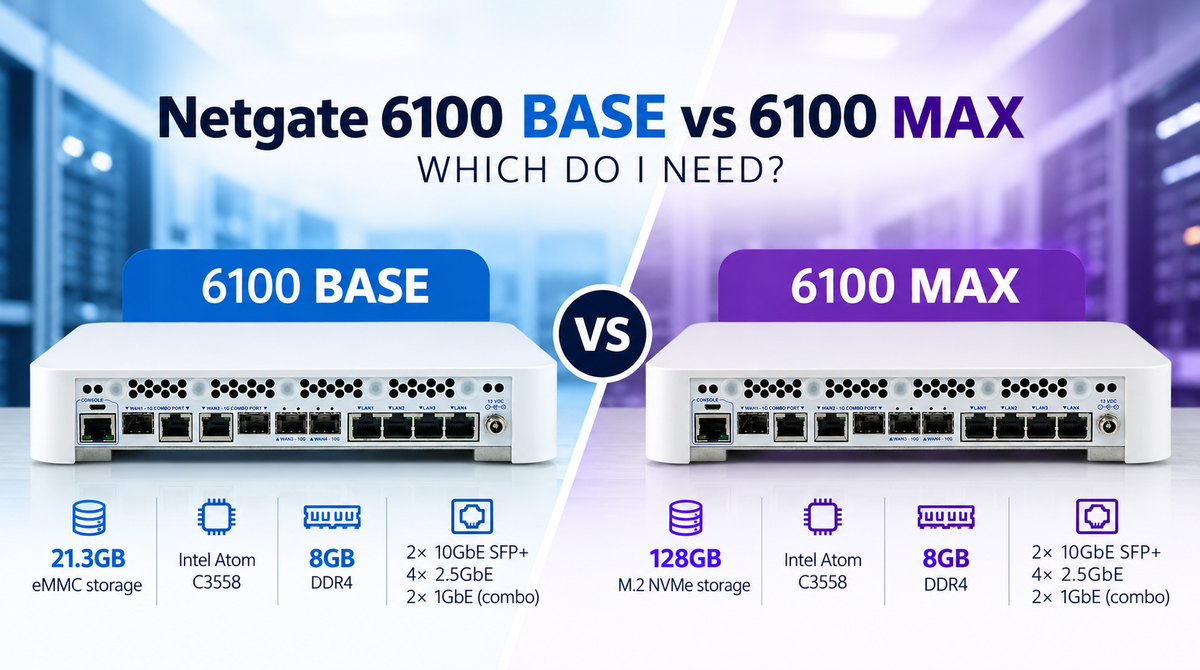
Netgate 6100 BASE vs 6100 MAX: Which Do I Need?
The Netgate 6100 BASE and 6100 MAX share the same processor, memory and network interfaces. The main difference is storage. Here’s how to decide which version is right for your business.
Quick answer
Choose the Netgate 6100 BASE if you need the full 6100 networking platform for firewalling, routing, VPN, VLANs, 2.5GbE and 10GbE connectivity without heavy local storage demands. Choose the Netgate 6100 MAX if you want much more storage for IDS/IPS, logs, pfBlockerNG, additional packages and future expansion.
Netgate 6100 BASE
21.3GB eMMC storage
Best suited to businesses needing the full 6100 networking platform without requiring large amounts of local storage.
Netgate 6100 MAX
128GB M.2 NVMe storage
Best suited to more storage-intensive pfSense Plus deployments, including IDS/IPS, local logging and multiple additional packages.
Netgate 6100 BASE vs 6100 MAX at a glance
| Feature | 6100 BASE | 6100 MAX |
|---|---|---|
| Processor | Intel Atom C3558 | Intel Atom C3558 |
| Memory | 8GB DDR4 | 8GB DDR4 |
| Storage | 21.3GB eMMC | 128GB M.2 NVMe |
| 10GbE | 2 × SFP+ | 2 × SFP+ |
| 2.5GbE | 4 × RJ45 | 4 × RJ45 |
| pfSense Plus | Included | Included |
| Best suited to | Standard 6100 deployments | Storage-heavy or longer-term deployments |
What is the main difference between the Netgate 6100 BASE and MAX?
The main difference is internal storage.
The Netgate 6100 BASE includes 21.3GB of onboard eMMC storage, while the Netgate 6100 MAX includes a 128GB M.2 NVMe SSD.
Both models use the same processor, the same 8GB of DDR4 memory and the same network interface configuration.
When is the Netgate 6100 BASE enough?
The Netgate 6100 BASE can be an excellent choice when your requirements are primarily focused on networking rather than local data storage.
If your firewall is primarily handling traffic and your important logs are exported to another system, 21.3GB of onboard storage may be perfectly adequate.
Why choose the Netgate 6100 MAX?
The MAX model increases storage to 128GB M.2 NVMe, giving you substantially more room for applications, logs and future requirements.
The 6100 MAX is particularly worth considering for:
- Snort
- Suricata
- pfBlockerNG
- Longer local log retention
- Additional pfSense Plus packages
- More storage-intensive security configurations
- Businesses wanting additional future headroom
Should I choose the 6100 MAX for IDS/IPS?
If intrusion detection or intrusion prevention forms an important part of your deployment, the 6100 MAX is worth considering.
Tools such as Snort and Suricata may use additional storage for rules, packages, logs and related data.
The BASE model can still run additional pfSense functionality, but 128GB of storage gives you much more room to grow compared with 21.3GB.
What about pfBlockerNG?
pfBlockerNG can use multiple IP and DNS feeds and may generate additional information and logs depending on how it is configured.
A relatively simple pfBlockerNG installation does not automatically require the MAX model.
However, if you plan to combine pfBlockerNG with IDS/IPS, extensive logging and several other packages, the additional storage available on the 6100 MAX becomes much more useful.
Is the Netgate 6100 MAX faster?
Not in the way many buyers initially assume.
Both the BASE and MAX models use the same Intel Atom C3558 processor, the same 8GB DDR4 memory and the same network ports.
6100 MAX = 128GB M.2 NVMe storage
If your requirement is greater firewall, VPN or routing performance, moving from BASE to MAX is not the answer.
In that case, you should compare the 6100 against a higher-performance Netgate appliance rather than selecting MAX simply because of the name.
Why is the Netgate 6100 popular for business networks?
One of the strongest features of the Netgate 6100 is its flexible network connectivity.
It provides a combination of 10GbE SFP+, 2.5GbE RJ45 and 1GbE connectivity, making it suitable for businesses moving beyond traditional gigabit networking.
Suitable for high-speed uplinks and fibre connectivity.
Useful for multi-gigabit LAN and WAN connectivity.
Additional flexibility for traditional network connections.
Is 21.3GB enough for pfSense Plus?
For many deployments, yes.
A firewall does not necessarily require hundreds of gigabytes of local storage. If you're primarily using the appliance for routing, firewalling, VPN, VLANs, DHCP and DNS, the BASE configuration may comfortably meet your needs.
Storage becomes more important as additional packages and local data accumulate.
Should I buy the MAX for future-proofing?
This depends on your budget and how long you expect to keep the appliance.
Business firewalls are often deployed for several years. During that time, requirements can change.
You may add new security packages, retain more logs, or introduce functionality that was not part of the original deployment.
Having 128GB available gives you significantly more storage flexibility.
Can I upgrade a Netgate 6100 BASE later?
The Netgate 6100 platform supports M.2 NVMe storage, so upgrading the storage later may be possible.
However, this is not the same as plugging in an external drive. It involves working with the appliance's internal hardware and correctly handling the pfSense Plus installation.
If you already know that you will want substantially more local storage, buying the MAX configuration from the beginning may be simpler.
Our recommendation
Choose the Netgate 6100 BASE if:
You mainly need the 6100 for firewalling, routing, VPN, VLANs and multi-gigabit networking, and 21.3GB comfortably covers your local storage requirements.
Choose the Netgate 6100 MAX if:
You plan to use IDS/IPS, pfBlockerNG, additional packages, more local logging, or simply want significantly more storage headroom.
What else should I consider before buying?
Choosing between BASE and MAX is only one part of appliance sizing. You should also consider:
- Internet connection speed
- Number of users and devices
- Number of VLANs
- Site-to-site VPN requirements
- Remote-access VPN users
- IDS/IPS requirements
- 2.5GbE connectivity requirements
- 10GbE connectivity requirements
- Multi-WAN and failover
- High Availability requirements
- Expected future growth
Buy Netgate 6100 appliances in the UK
Telappliant is a Netgate Premier Partner in the UK. If you're unsure whether the 6100 BASE or 6100 MAX best suits your network, our team can help you select the right appliance and configuration.
View Netgate Appliances Netgate Premier Partner UKNetgate 6100 BASE vs MAX FAQs
What is the main difference between the Netgate 6100 BASE and 6100 MAX?
The primary difference is storage. The 6100 BASE includes 21.3GB eMMC storage, while the 6100 MAX includes 128GB M.2 NVMe storage.
Does the Netgate 6100 MAX have a faster processor?
No. Both configurations use the same Intel Atom C3558 processor.
Does the 6100 MAX have more RAM?
No. Both the BASE and MAX configurations include 8GB DDR4 memory.
Is the Netgate 6100 MAX faster than the BASE?
The MAX uses NVMe storage rather than eMMC, but it should not be treated as a higher-throughput networking model. The CPU, RAM and network interfaces are the same.
Do I need the 6100 MAX for Snort or Suricata?
Not necessarily, but the extra storage can be useful for IDS/IPS deployments where additional rules, logs and package data are stored locally.
Is the Netgate 6100 MAX worth it?
If your deployment is simple and 21.3GB comfortably meets your needs, the BASE may be enough. If you expect heavier logging, IDS/IPS, pfBlockerNG or multiple additional packages, the MAX offers much more storage flexibility.